

Father’s Day Questionaire for the Classroom
If you need a Father’s Day questionaire that students can finish quickly, enjoy answering, and proudly take home, keep it simple and personal. The best versions are not the fanciest ones. They are the ones that make kids smile, give families a genuine keepsake, and fit into your real classroom day without turning into another prep-heavy project.
For elementary teachers, that matters a lot. June is already packed with assessments, report cards, transitions, and end-of-year energy levels that are all over the place. A Father’s Day activity should feel easy to run, easy to differentiate, and worth the time. A good questionnaire does exactly that.
Why a Father’s Day questionaire works so well
There is a reason teachers come back to this activity every year. Kids love sharing what they know about the important adults in their lives, and the answers are often hilarious, sweet, and completely unforgettable. Families love reading them because they capture a child’s voice at a specific age. You are not just sending home a worksheet. You are sending home a memory.
It also works across a wide range of classrooms. In a primary setting, a questionnaire gives even very young learners a manageable writing task with a clear purpose. In French immersion, FLE, or FSL classes, it becomes a meaningful language activity built around familiar vocabulary and sentence frames. Students can practice describing a person, sharing preferences, and expressing affection in a context that feels real.
That balance is what makes it such a smart choice. You get literacy practice, speaking opportunities, and a giftable end product in one lesson.
What to include in a Father’s Day questionaire
The strongest classroom questionnaires are short enough to finish in one sitting but thoughtful enough to feel special. For most elementary students, 8 to 12 prompts is the sweet spot. Fewer than that can feel a little thin. More than that can drag, especially if you are working with emerging writers.
A good mix usually includes simple factual prompts, opinion-based prompts, and one or two open-ended questions. For example, students can answer questions about what their dad or special person likes to eat, what job they do, what they are good at, or what makes them funny. Then you can add reflective prompts like, “My dad is the best because…” or “My favorite thing to do with him is…”
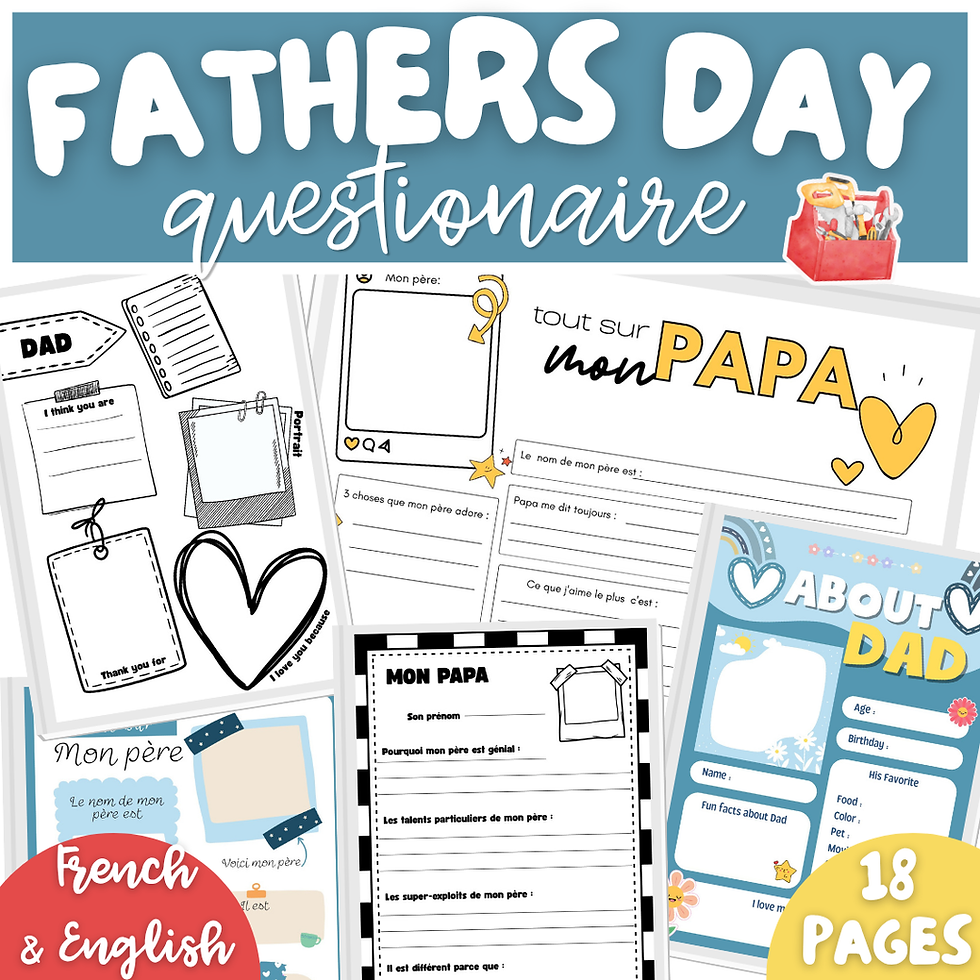
This is where the magic happens. The factual questions get students writing. The personal questions create the keepsake.
If you teach in French, keep your language targets clear. You might focus on age, appearance, hobbies, favorites, or simple present-tense verbs. Students do better when the questionnaire reinforces language they have already practiced rather than introducing too much at once.
Questions that are age-appropriate and actually fun
The best prompts are concrete. Young learners can answer “My dad’s favorite food is…” much more easily than “How would you describe his personality?” You know your students. If they are still building confidence as writers, simple stems are your friend.

Funny questions help too, but they need to stay accessible. Questions like “He always says…” or “He is really good at…” usually lead to charming answers without confusing students. Asking a six-year-old to estimate salary, age, or anything too abstract can go sideways fast. Sometimes that is funny. Sometimes it creates awkward family moments you did not sign up for.
A classroom-safe Father’s Day questionaire should feel warm, light, and developmentally appropriate.
Make it inclusive from the start
This is the part that matters most. Not every child has a dad at home, and not every family celebrates Father’s Day in the same way. The easiest fix is to design the activity around a “dad or special person” format from the beginning. That small choice makes the activity more flexible and more comfortable for everyone.

You can let students complete it for a father, stepdad, grandfather, uncle, foster parent, older brother, or another trusted adult. Some teachers prefer offering a choice between a Father’s Day version and a more general “special person” version. That works well, especially if you want students to select someone meaningful without having to explain their family structure in front of peers.
It helps to introduce the activity casually and confidently. When you normalize options, students usually move forward without stress. That saves emotional energy for them and for you.
In bilingual or French classrooms, the same rule applies. Keep the language inclusive and easy to adapt. A flexible title and editable prompt wording can make a big difference.
How to use a Father’s Day questionaire in French class
If you teach French, this activity gives you a lot of mileage without adding complicated prep. You can use it as a writing task, a speaking activity, or both.
Before students complete the page, quickly review useful vocabulary. Go over family words, adjectives, favorite activities, and sentence starters. Model a few answers together. You might describe a pretend dad as a class, or invite students to orally rehearse their answers with a partner before writing.

For newer learners, sentence frames are essential. They reduce hesitation and help students focus on meaning instead of getting stuck on every word. For more confident learners, you can leave a few prompts open-ended so they have room to write fuller responses.
The nice thing is that the final product still feels celebratory, not academic. Students are practicing real language, but to them it feels like making a gift.
Easy differentiation that saves time
This activity is easy to adjust across grade levels. For kindergarten or first grade, you can read each question aloud and have students dictate answers, copy short phrases, or illustrate some responses. For older elementary students, you can ask for complete sentences and add a final written message.
If you have mixed proficiency levels in French, provide two versions. One can include sentence stems and a word bank. The other can be more open. That one small adjustment can make the lesson run much more smoothly.
Digital options also help if your class is already using Google Slides or Google Forms. Some teachers prefer printable keepsakes because they feel more gift-ready. Others like digital completion first, then print the polished final version. It depends on your classroom setup and how much independent tech use your students can handle.
Keep the project simple, polished, and gift-ready
A questionnaire does not need a huge craft component to feel special. In fact, too much crafting can tip the activity from meaningful to exhausting very quickly. If your goal is a manageable end-of-year win, keep the design clean.
A one-page questionnaire with a student portrait, border, or small coloring section is often enough. If you want to elevate it a bit, mount it on construction paper or pair it with a simple cover page. That gives families something nice to keep without adding an hour of cutting and gluing.
This is where ready-to-use materials can really earn their place in your planning. When a resource is already designed, leveled, and classroom tested, you are not spending your prep time adjusting spacing, rewriting prompts, or trying to make everything look polished at 9:30 p.m. That is exactly why so many teachers rely on done-for-you seasonal resources from places like French Teacher Box when the calendar gets crowded.
Common mistakes to avoid
The biggest mistake is making the questionnaire too long. Students lose momentum, and what should feel sweet starts feeling like work. The second is choosing prompts that are too hard, too vague, or too personal.
Another common issue is forgetting about inclusivity until the last minute. If you have to improvise alternatives on the spot, the activity can feel awkward. Build in options from the beginning and you will avoid that problem entirely.
Finally, do not underestimate the value of modeling. Even a fun activity needs structure. When students hear sample answers first, they write more confidently and need less one-on-one help.
A keepsake families actually hold onto
There are plenty of seasonal activities that fill time. A good Father’s Day questionaire does more than that. It gives students a real reason to write, lets you practice meaningful language in a low-stress way, and sends home something families will genuinely want to save.
And that is what makes it worth doing. Not because it is elaborate, and not because it checks a holiday box, but because it captures the funny, honest, wholehearted way children see the people they love. In a busy classroom, that kind of activity is more than manageable. It is memorable.


Comments